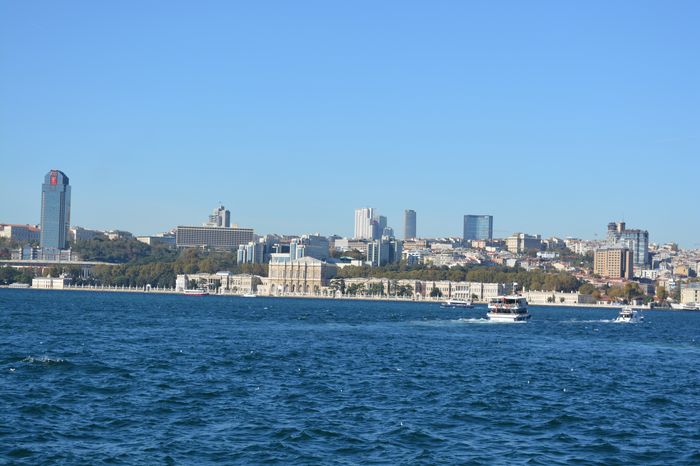
In front of the land area enclosed by the ancient wall described earlier, there are important remains along the shoreline. Offshore lies a stone mole made of large boulders. On Stolpe’s map of Constantinople, this structure is marked as “Molotriümmer.” Its form is very similar to the mole that once protected the old harbour at Koum Kapoussi, suggesting that it served a comparable purpose.
This mole does not form one continuous barrier. About halfway between Koum Kapoussi and Yeni Kapou, there is a wide opening that divides the mole into two unequal parts. This gap clearly functioned as an entrance, allowing ships to pass through into calmer waters behind the protective structure Sources and Eyewitness Information.
The Former Shoreline and Basin Area
Opposite this opening, the shoreline once had the natural features expected of a harbour basin. Before the construction of a modern quay in 1870 for the Roumelian railway, the area consisted of a sandy beach that stretched back toward the city walls. This beach provided space where ships could be drawn close to land for loading and unloading.
The section of city wall behind this beach is also noteworthy. It is not entirely Byzantine in date. Instead, a portion of Turkish construction was inserted between older Byzantine walls. This later work was built to close an opening that once allowed access into the area occupied by the Tulbendji Djamissi quarter. This alteration supports the idea that the area had earlier been open and functional, consistent with harbour activity.
Clear Signs of an Ancient Harbour
Taken together, these elements form a complete picture of a harbour. There is a mole built to protect ships from waves, a clear entrance through that mole, a basin area where vessels could anchor, and an enclosing wall marking the harbour’s limits. These features strongly indicate that this site was once an organized port facility.
Because of this evidence, it is reasonable to identify this location as the Neorion at the Heptascalon. This conclusion fits well with the descriptions given by Cantacuzene and Nicephorus Gregoras, both of whom clearly distinguish the Neorion at the Heptascalon from the Kontoscalion. The physical remains along this stretch of coast support the same distinction Sofia Tours Guide.
A Possible Location for the Harbour of Kaisarius
It is also possible that the Harbour of Kaisarius was located at this same point. One historical detail supports this idea: a fire is recorded as having started at the Harbour of Kaisarius and then spreading inland through the valley that runs from Vlanga to Ak Serai. This pattern of spread would make sense if the harbour stood in the area described here.
Patriarch Constantius and a Different View
Despite this reasoning, Patriarch Constantius held a different opinion. After examining the ruins uncovered in 1819, he believed that the harbour discovered at that time was actually the Kontoscalion. His view deserves careful consideration, as he was an experienced observer and had direct access to the remains.
Some historical sources, such as Pachymeres and Bondelmontius, state that the Kontoscalion was near Vlanga. However, this description alone does not settle the matter. Because Vlanga lies close to Koum Kapoussi, a harbour situated in front of Koum Kapoussi might still be described as being “near Vlanga.”
The Strongest Argument for the Patriarch’s View
The most serious argument in favor of Patriarch Constantius’s identification lies in the wall itself. The wall he examined closely matches historical descriptions of the wall built by Emperor Michael Palaiologos to enclose the Kontoscalion. The size, construction, and form of the wall correspond well with what the written sources say about that structure.
The remains along the shore between Koum Kapoussi and Yeni Kapou clearly show the essential features of a harbour. These features strongly support the idea that the Neorion at the Heptascalon was located here. At the same time, the similarity between the discovered wall and historical descriptions of the Kontoscalion introduces a real difficulty. While the evidence leans toward identifying the site as the Neorion at the Heptascalon, the question cannot be considered fully settled. The remains may reflect overlapping phases of harbour use, or later rebuilding of an earlier port, leaving room for continued scholarly debate.